
Acupuncture for Sciatica Nerve Pain in Pinner
If you have ever experienced the sharp, radiating pain that travels from the lower back down the leg, you will know that sciatica is far more than ordinary back pain. For many people it disrupts sleep, walking, sitting, and even simple daily activities.
At VitalQi Acupuncture, acupuncture for sciatica in Pinner, many patients seek acupuncture when sciatic nerve pain persists or returns repeatedly despite medication, physiotherapy, or rest. Acupuncture is increasingly recognised as a supportive treatment option that may help ease pain while encouraging longer-term recovery.
Clinical research continues to explore the benefits of acupuncture for sciatica. A 2024 randomised clinical trial published in JAMA Internal Medicine found that a course of acupuncture treatments produced greater pain reduction and improved physical function compared with placebo acupuncture, with benefits lasting up to 52 weeks.
Understanding Sciatica and Sciatic Nerve Pain
Sciatica is not a medical diagnosis in itself—it is a symptom of an underlying lumbar spine problem. It refers to the pain, tingling, or numbness that radiates along the path of the sciatic nerve, which is the longest nerve in your body.
This nerve originates in your lower back, runs through your hips and buttocks, and branches down each leg , making it one of the most important pathways for movement and sensation. When this nerve is “pinched” or irritated, the pain can range from a mild ache to a sharp, burning sensation or even an excruciating jolt.
People experiencing sciatica often describe symptoms such as:
- Pain that travels from the lower back into the buttock and down the leg
- Sharp or burning nerve pain that may worsen when sitting
- Pins and needles or tingling in the leg or foot
- Pain when standing up or getting out of bed
- Discomfort that interrupts sleep or makes walking difficult
What is the Sciatic Nerve
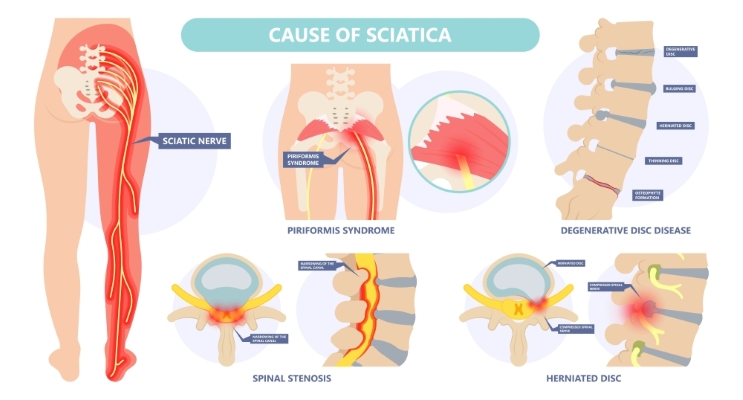
The sciatic nerve is the largest nerve in the body. It starts in the lower back, passes underneath the piriformis muscle in the buttock, and then travels down the back and side of the leg all the way to the foot. Because it covers such a long path, it plays an important role in both movement and sensation throughout the lower limb.
Common Causes of Sciatica
Sciatic nerve pain is usually caused by structural changes affecting the lower spine or surrounding soft tissues, including:
- Herniated or bulging discs – the most common cause, where disc material presses on a nerve root
- Lumbar spinal stenosis – narrowing of the spinal canal that places pressure on nerves
- Piriformis syndrome – when a tight muscle in the buttock irritates the nerve
- Spondylolisthesis – when one vertebra slips forward over another
- Pregnancy – hormonal and postural changes that increase pressure on the lower back
Sciatica occurs when the sciatic nerve becomes irritated, compressed, or inflamed. Conventional medical management may include medication, physiotherapy, injections, or occasionally surgery depending on severity.
Many people explore Acupuncture as an additional approach to help reduce pain and support recovery.
Where Can Sciatica Pain Be Felt?
Sciatica symptoms can vary from person to person, but many people recognise the pattern of pain travelling down the leg. Because the sciatic nerve travels from the lower back to the foot, symptoms can appear anywhere along this path. People often feel:
- Glute pain — from irritation near the piriformis muscle
- Pain down the back of the leg — following the nerve’s main route
- Pain on the outer side of the thigh — where the nerve runs along the lateral leg
- Calf pain — because the nerve branches at the knee and continues downward
- Foot or toe symptoms — depending on which branch of the nerve is affected
Pain may feel sharp, burning, shooting, or tingling, and may worsen when sitting for long periods or when standing up. Symptoms may appear suddenly after lifting, twisting, or prolonged sitting, or they may develop gradually over time.
Why Sciatica Affects Movement?
The sciatic nerve carries both sensory (feeling) and motor (movement) signals. That means irritation doesn’t just cause pain — it can also affect how the leg moves. Some people notice:
- Weakness
- Difficulty lifting the leg
- Trouble standing or walking comfortably
- A feeling that the leg is “not working right”
This happens because the nerve helps control several muscles in the thigh, leg, and foot.
How Acupuncture May Help Treat Sciatic Nerve Pain
Acupuncture treatment does not simply mask pain signals. Instead, it aims to support the body’s natural regulatory systems — encouraging improved circulation, reduced muscular tension, and calmer nervous system activity.
Research suggests acupuncture may help by:
- Reducing Inflammation – Acupuncture may help calm inflammation around the sciatic nerve, which can reduce pressure and pain.
- Releasing Tight Muscles –Tension in the lower back, glutes, and hips can irritate the sciatic nerve. Acupuncture may help relax these muscles and ease nerve compression.
- Improving Circulation – Better blood flow supports healing and reduces stiffness, which may help improve mobility.
- Supporting the Nervous System – Acupuncture is often used to promote relaxation and help regulate pain signals, which may reduce the intensity of sciatic discomfort.
Emerging evidence also suggests acupuncture may support nerve recovery and improve nerve conduction in some cases.
When Should You Seek Help for Sciatica?
Many cases of sciatica improve gradually over several weeks. However, persistent or worsening symptoms should be assessed by a healthcare professional. You may wish to seek support if:
- Pain continues for more than a few weeks
- Symptoms are recurrent or becoming more frequent
- Pain significantly interferes with sleep, walking, or daily activities
- You experience persistent numbness or weakness in the leg
In rare cases, urgent medical assessment is required, particularly if symptoms include loss of bladder or bowel control or severe progressive weakness.
For many people with ongoing sciatica, supportive treatments that reduce nerve irritation and improve movement can help recovery.
Acupuncture is often used to help ease pain while supporting the body’s natural healing processes. Many patients seek acupuncture when sciatic nerve pain persists despite physiotherapy or medication. You can learn more about how acupuncture works on our Acupuncture for Pain page.
Sciatica Acupuncture Treatment in Pinner
Sciatica is a common condition seen in clinic. Treatment is adapted to your individual presentation, taking into account how long symptoms have been present, activity levels, and any contributing biomechanical factors.
In clinic, many people arrive worried that their symptoms may become permanent. In most cases, sciatica improves with the right combination of care, movement and time.
The aim of acupuncture treatment is to reduce pain, improve movement, support sustainable recovery and help you return to normal daily activities.
A typical course of acupuncture treatment involves around six to eight sessions, usually beginning weekly. Acupuncture treatment is cumulative, meaning the effects build gradually over several sessions.
Many people notice meaningful improvement in pain and mobility during this period
What Our Patients Say
After 4 months on heavy painkillers for slipped discs, I found Malti and was able to reduce my meds. However, you need the right type of acupuncture, I tried a nearer one with no success at all and returned to Malti. Another 3-4 sessions and I was off my meds altogether. My Pilates exercises had clicked my back straight and I was no longer looking at injections or an operation. The acupuncture reduced the inflammation and the 1:1 Pilates did the repair. Thank you so much Malti
Acupuncture for Sciatica in Pinner
While every case is unique, many patients begin to notice improvement within 3–5 treatments, although chronic or long-standing sciatica may require a longer course.
Not at all. Acupuncture needles are hair-thin—nothing like the needles used for shots or blood draws. Most patients feel a slight “heavy” sensation or a mild tingle when the needle reaches the point, followed by a deep sense of relaxation.
Initially acupuncture is excellent for immediate pain relief, reducing inflammation and reducing muscle spasms followed by physical therapy (and techniques like nerve flossing) which focuses on structural alignment and strength.